
Your baby is awake, fed, changed, and staring at you. Now what? New parents hear constantly that babies need stimulation, but many infant activities online are either too advanced for the first year or complicated enough to require a craft drawer.
The good news is much simpler. During the first year, your face, voice, floor space, and a few safe objects can provide remarkably rich play. In this guide, Mariana Korsunsky, Director of Education at Little Scholars, shares developmentally appropriate activities. You’ll find ideas for every stage from birth through the first birthday.
Why Infant Play Isn’t Just Play
Infant play supports motor, cognitive, language, sensory, and social-emotional development at the same time. A baby turning toward your voice, for example, is practicing attention, listening, head movement, and social connection during one tiny interaction. That is why some of the most useful baby developmental activities look surprisingly ordinary.
You do not need to make every waking minute educational. Talking during a diaper change, giving your baby room to kick, or pausing after a coo so they can “answer” all create opportunities to learn. The developmental value comes from repeated, responsive interaction, not from how elaborate the activity looks.
At Little Scholars, this principle also informs how infant play is approached in a classroom environment. Educators can observe what interests a baby, offer an appropriate experience, and adjust according to the child’s response rather than expecting every infant to participate in exactly the same way. This educator perspective is important because the content brief found that competing infant-activity guides rarely explain what purposeful play looks like in professional early childhood settings.
Read Your Baby’s Cues Before Adding More Stimulation
The right amount of play is the amount your baby can comfortably handle. More stimulation is not automatically better, especially during the newborn months. Even ordinary sights, sounds, and movements are still new experiences. Learning when your baby wants interaction and when they need a break is part of responsive play.
A baby who is ready to interact may look toward your face, follow an object with their eyes, move toward an interesting sound, or simply appear calm and alert. Signs that they have had enough can include repeatedly turning away, increasing fussiness, stiffening or arching, frantic movements, yawning, or suddenly losing interest. These behaviors do not necessarily mean the activity was wrong; they may simply mean the session is over.
For a newborn, a few focused minutes can be plenty. A little tummy time and a chat during a diaper change may be enough. Your baby may then enjoy a few quiet minutes looking at your face before needing rest. Think of attention like a tiny cup: offer an experience, watch the response, and stop before the cup overflows.
Infant Activities for 0 to 3 Months
Activities for a 0-3 month old baby should focus on connection, sensory discovery, early movement, and communication. Newborns do not need elaborate toys because looking, listening, moving, and interacting already demand enormous effort. This is also the age range most competing guides underdevelop, making practical newborn guidance one of the most useful parts of this guide.
Infant Activities for 1 to 2 Months
1. Try tummy time on your chest. Recline comfortably and place your awake baby chest-down against you while remaining fully attentive. Your face provides a natural reason to lift or turn their head, while your body offers an alternative starting position for babies who immediately protest traditional floor tummy time.
2. Let your baby study your face. Hold your baby comfortably and talk to them from close range. Give them plenty of time to study your face. Change your expression slowly, smile, and pause rather than constantly trying to capture their attention. Face-to-face interaction combines visual stimulation with the earliest forms of social communication.
3. Show simple high-contrast patterns. Present a black-and-white card or another simple pattern where your baby can comfortably see it, then give them time to focus. You can move it slowly from side to side and watch whether their eyes attempt to follow. The goal is not to train your newborn’s vision but to provide an interesting and manageable visual experience.
4. Narrate care routines. Tell your baby what is happening while you change, dress, feed, or carry them: “I’m lifting your legs. Here’s your clean diaper. Now your pajamas go back on.” Your baby cannot understand those sentences yet, but they are hearing language connected with predictable experiences. Talking through ordinary routines is one of the easiest ways to build language exposure into a newborn’s day.
5. Make room for quiet physical connection. Holding, cuddling, and skin-to-skin contact offer rich tactile and social experiences. You do not need any toys to make these moments meaningful. You can speak softly, hum, or simply allow your baby to rest against you while awake and safely positioned. Some of the most valuable newborn activities barely look like “activities” at all.
6. Add gentle rhythmic movement. Hold your baby securely while swaying or rocking slowly and pay attention to their response. The movement itself provides a new sensory experience, while your voice or humming can add a predictable rhythm. Keep movements gentle and stop when your baby shows signs that they have had enough.
7. Hum and sing familiar songs. Your voice is already one of the most interesting sounds in your baby’s environment, so you do not need a special infant playlist. Repeat simple melodies and leave occasional pauses while watching your baby’s expression and movements. Singing combines language, rhythm, familiarity, and connection in one activity that requires no preparation.
Infant Activities for 2 to 3 Months
As alertness, head control, and visual tracking develop, you can build on earlier newborn activities instead of replacing them. The difference at this stage is often greater participation, with babies watching longer, cooing back, lifting their heads, or making increasingly purposeful movements. Familiar play can therefore become more challenging without becoming more complicated.
1. Progress tummy time gradually. Give your awake baby opportunities for supervised tummy time on a firm floor surface, getting down at eye level or positioning something interesting within view. If your baby strongly resists, try shorter and more frequent opportunities or return temporarily to chest-to-chest positioning. Tummy time should be an opportunity to practice movement, not a battle that has to reach a particular number on a timer.
2. Encourage visual tracking. Move a simple toy slowly across your baby’s field of view and give their eyes time to follow. Pause if they lose the object rather than immediately waving it around to regain their attention. The activity is effective precisely because it is slow enough for your baby to process what is happening.
3. Invite batting and reaching. Position a lightweight, baby-safe toy where your baby can see it and potentially make contact during supervised play. An accidental swat can produce movement or sound, introducing an early experience of cause and effect. As coordination develops, those accidental contacts can gradually become more purposeful.
4. Have a conversation without words. Talk to your baby, pause after they coo or vocalize, and then respond as though they have contributed something important. Their sounds do not need to resemble words for the exchange to matter. These tiny back-and-forth interactions introduce the rhythm of conversation months before recognizable first words.
5. Explore a baby-safe mirror. Let your baby look at the reflection while you describe the face and movements they see. They will not yet understand that the reflection represents themselves, but faces and movement can hold their attention. Mirror play also gives you another natural reason to talk, smile, pause, and respond.
The best sensory activities for infants during these early months are often the simplest ones. Your voice, face, touch, movement, contrasting images, and changing positions already provide a wide range of sensory information. Repeating familiar experiences is usually more useful than trying to invent something novel every day.
Infant Activities for 3 to 6 Months
Between 3 and 6 months, play becomes noticeably more active. Many babies gain better head control and become more interested in reaching and grasping. They may also work toward rolling and pay closer attention to people and objects. The best activities for a 3-month-old baby still rely heavily on interaction, while later activities can introduce more opportunities for reaching, rolling, supported sitting, texture exploration, and cause and effect.
1. Put interesting objects just within reach. Place a lightweight, baby-safe toy slightly to your baby’s side during floor play. Keep it close enough that reaching feels possible rather than frustrating. Reaching gives your baby opportunities to coordinate vision and hand movement, while positioning the toy slightly to one side can encourage shifting their weight. Give them time to investigate how to get closer before repositioning the object for them.
2. Explore different textures. Let your baby feel a soft washcloth, textured ball, crinkly fabric, or another baby-safe object while you describe the experience. Simple language such as “This one feels soft” or “Here’s the bumpy one” connects sensory exploration with words. Because babies at this age commonly explore objects with their mouths, use items that are safe for mouthing, avoid loose or detachable parts, and supervise closely.
3. Practice assisted rolling. Place an interesting object slightly to one side and watch whether your baby turns toward it. If they begin attempting to roll, provide only the gentle support they need rather than completing the entire movement for them. Being moved is different from learning to coordinate your own body. Give your baby time to do as much of the movement as they comfortably can.
4. Play peekaboo. Hide your face briefly behind your hands and then reappear, keeping the game slow enough for your baby to follow. Repeated disappearing and reappearing begins introducing the idea that something can exist even when it temporarily leaves view. As the game becomes familiar, you may notice your baby anticipating the moment your face returns.
5. Read short board books together. Choose sturdy books with clear pictures and let your baby’s attention determine the pace. Point to pictures, name what you see, vary your voice, and let your baby look at or reach toward the page rather than insisting on finishing the story. If you spend two minutes discussing one picture of a dog and never reach page three, the interaction has still done its job.
6. Sing songs with simple movements. Familiar songs can combine language, rhythm, repetition, social interaction, and movement in a single activity. You can gently move your baby’s hands or legs with the rhythm when they are comfortable, then watch for smiles, kicks, or vocalizations as the song becomes familiar. Repetition may feel boring to an adult, but for an infant it creates patterns they can begin to recognize and anticipate.
7. Try supported sitting play. Once your baby is developmentally ready to practice sitting with appropriate hands-on support, sit on the floor with them and place a toy where it can be explored comfortably. This gives them a different view of their surroundings while providing another position from which to interact with you and nearby objects. Think position before product, because changing how your baby safely experiences the floor can provide more interesting play than buying another toy.
Infant Activities for 6 to 9 Months
From 6 to 9 months, babies often become determined explorers. Sitting may become steadier, objects travel from hand to hand and frequently to the mouth, babbling becomes richer, and some babies begin working toward crawling or another form of independent movement. At this stage, good activities increasingly give your baby something to investigate while allowing them time to discover what happens.
1. Hide a toy partly under a cloth. Let your baby watch as you partially cover a familiar toy with a lightweight cloth, initially leaving part of the object visible. Give them time to investigate or pull the cloth away before you intervene. Once the game becomes easy, you can cover more of the object and see what your baby does next.
2. Create a reason to move. Place a favorite toy a short distance away during supervised floor time so your baby has an interesting destination. If they are beginning to pivot, scoot, crawl, or move in another way, let them initiate the effort rather than positioning their body for them. Avoid turning crawling into a test because babies develop mobility differently and do not all follow exactly the same sequence.
3. Play fill and dump. Give your baby a shallow container and several large, baby-safe objects, then demonstrate putting one inside and taking it out. Your baby may decide that dumping everything onto the floor is far more interesting than putting anything back, and that is completely appropriate. Filling, dumping, grasping, and releasing provide fine motor practice while helping babies investigate how objects relate to containers.
4. Encourage hand-to-hand transfers. Offer a safe object while your baby is already holding something in the other hand and watch how they solve the problem. They may drop the first object, transfer it, bang the two together, or simply inspect the new arrival. Each response provides practice with coordination and increasingly deliberate object manipulation.
5. Have longer babble conversations. When your baby says “ba-ba-ba,” answer and then leave a pause for another response. Babbling does not need to sound like a real word to deserve a response. Answering your baby helps reinforce the back-and-forth rhythm of communication. You can imitate your baby’s sound and then introduce a slightly different one while using facial expressions and gestures to keep the exchange social.
6. Add closely supervised water play. A small amount of water can create an interesting sensory experience when an adult remains within immediate reach and actively supervises throughout. Let your seated baby splash, pat the surface, or explore a wet washcloth while you narrate what happens. Water play can combine sensory exploration, movement, language, and cause and effect, but active supervision should never be relaxed for the sake of the activity.
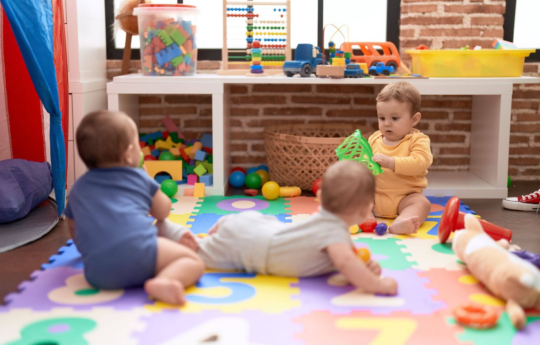
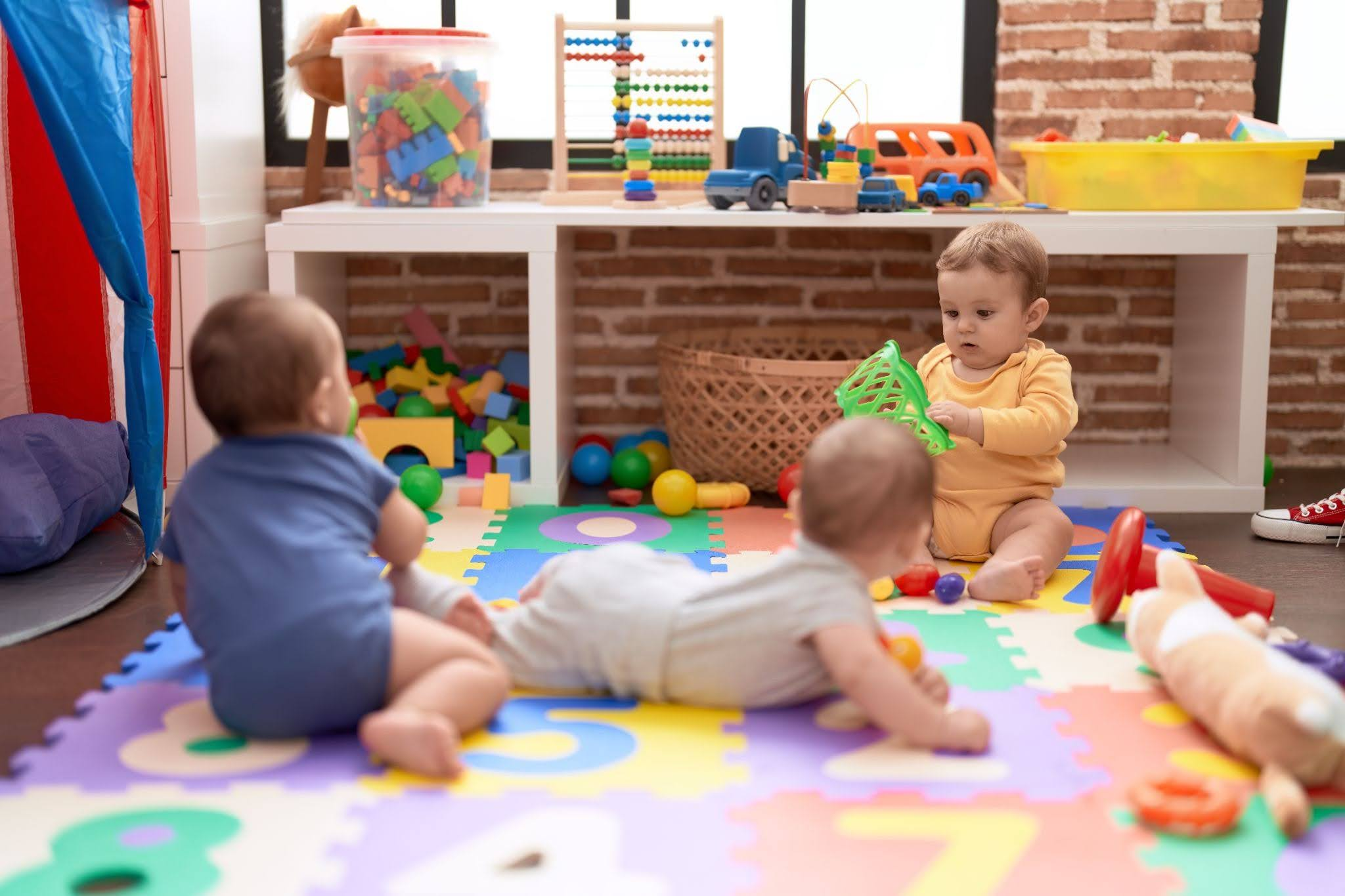
7. Let babies notice other babies. Social development begins well before children are ready for cooperative play, and babies may already watch another infant, smile toward them, vocalize, or react when another child laughs. An infant classroom creates natural opportunities for babies to notice one another. Supervised floor play, shared songs, and mirrors can gently encourage these early interactions. The developmental goal is not to make two eight-month-olds “play together,” but to give them opportunities to notice and respond to another person.
These ideas also work well for parents searching broadly for activities for a 6-12 month old baby, but the level of challenge should continue changing as your child develops. A baby who has just learned to sit will interact with a container very differently from a baby who can crawl across the room to find it. The activity can stay simple while your baby’s way of using it becomes more sophisticated.
Infant Activities for 9 to 12 Months
Between 9 and 12 months, your baby’s world can expand quickly. Movement becomes more purposeful, gestures carry more meaning, and ordinary household objects begin to look like puzzles waiting to be investigated. At this stage, useful infant activities increasingly give your baby room to act, experiment, imitate, and communicate rather than simply watch.
1. Support safe cruising practice. If your baby is pulling to stand, provide a stable and appropriately secured surface. They can practice standing and, when ready, moving sideways while holding on. Place an interesting object along the safe surface so that movement has a purpose instead of repeatedly positioning your baby’s body yourself. There is no prize for walking before the first birthday, so follow your child’s developmental pace while making the environment safer as mobility increases.
2. Stack cups or rings. Demonstrate placing one cup or ring on another and then give your baby a chance to investigate the materials. Your carefully built tower may survive approximately two seconds, but knocking it down is part of the learning rather than a failed attempt at stacking. Babies can explore size, position, force, spatial relationships, and cause and effect while grasping, releasing, stacking, and demolishing.
3. Read, point, and name. Book time becomes increasingly interactive as your baby starts following your point or using gestures themselves. Instead of reading every sentence, follow their attention and name the dog, ball, baby, or spoon that has captured it. This turns reading into shared attention while helping your baby connect pictures, real objects, gestures, and spoken words.
4. Play clapping and action songs. Songs with predictable words and gestures give older infants actions they can gradually begin to imitate. Clap together, wave during “hello” and “goodbye,” tap a rhythm, or pause before a familiar part of a song to see whether your baby anticipates what comes next. Music works particularly well during this period because a baby can participate physically and socially before being able to sing the words.
5. Make containers into puzzles. Put several safe objects into a container and let your baby remove them, then eventually demonstrate putting one back. You can vary the safe objects by size, shape, or texture without constructing an elaborate sensory bin. A cupboard filled with appropriate bowls and containers can sometimes inspire more investigation than a basket of electronic toys.
6. Play “Where’s Mama?” Ask “Where’s Mama?” or “Where’s Daddy?” and respond when your baby looks or points toward the right person. You can extend the game to familiar objects by asking about a cup, light, ball, or favorite toy. These simple exchanges connect words with people and objects while strengthening receptive language, which is the language a baby understands before necessarily being able to say it.
7. Introduce useful gestures. Toward the end of the first year, simple gestures can offer another way to communicate. You might pair words such as “more,” “milk,” or “all done” with consistent gestures. Continue saying the word as you make the gesture so visual and spoken communication work together. Gestures should support rich verbal interaction rather than replace the language your baby hears throughout the day.
The baby milestones emerging during this period can make play look dramatically different from the newborn stage, yet the underlying formula remains remarkably consistent. You observe, offer an opportunity, respond, and repeat while gradually giving your baby more room to act independently. As your baby approaches toddlerhood, play increasingly emphasizes mobility, imitation, exploration, and independence, which Little Scholars continues through its Toddler Program.
A quick note on screens: For infants, a screen does not need to fill the role of developmental play. When you need a simple alternative, try floor exploration, a board book, audio music, a safe household object, or letting your baby watch and listen while you narrate an ordinary task. The goal is not to entertain your baby every second they are awake, but to preserve plenty of opportunities for real-world movement, exploration, and responsive interaction.
How Music and Rhythm Grow With Your Baby
Music is particularly useful during infancy because the same activity can evolve as your baby develops. A newborn may listen to your humming, while an older infant may kick, clap, or bounce to a familiar song. You do not need a special playlist, musical toys, or a particularly good singing voice to create those experiences.
Try attaching familiar songs to predictable parts of the day. One song might accompany getting dressed, another might become part of playtime, and a quieter melody can signal that an active period is winding down. Repetition gives babies opportunities to recognize patterns while the words provide natural language exposure.
Live singing also gives you something a recording cannot provide: immediate responsiveness. If your baby smiles, squeals, kicks, pauses, or looks away, you can repeat a favorite part, change your tempo, or stop altogether. You can learn more about how music shapes early childhood development, which expands on the role of rhythm, movement, and repeated musical experiences.
What Do Infant Activities Look Like at Daycare?
A strong infant classroom should not resemble preschool shrunk down to baby size. Babies need responsive care, movement, sensory exploration, language, rest, and secure relationships. That means learning also happens during bottles, diaper changes, transitions, and quiet one-to-one moments. Looking at these ordinary moments helps explain what purposeful infant play can look like outside the home.
At Little Scholars, the Infant Program serves children from 3 to 12 months. An infant’s day can include songs, social interaction, floor play, tummy time, and sensory exploration. Language-rich caregiving and opportunities for movement continue throughout the day. Rather than requiring every infant to complete the same activity, responsive care leaves room for differences in development, temperament, feeding, sleep, and interest.
Group care also creates an element of infant play that is difficult to reproduce at home every day: repeated opportunities to notice peers. One baby laughs and another turns toward the sound. Two little explorers investigate similar toys nearby, or several babies respond differently to the same song. Educators do not need to force those interactions because simply creating a safe shared environment allows early social awareness to emerge naturally.
Care routines can be developmental experiences too. A teacher who talks during a diaper change, waits for a baby’s response, names what is happening, and gives the child time to participate turns necessary care into communication and relationship-building. The most meaningful infant curriculum is therefore not confined to a scheduled “activity time”; it is woven through the baby’s entire day.
No-Setup Baby Play Ideas for Busy NYC Days
Living in New York can make elaborate activity setups unrealistic, but the city itself supplies a steady stream of baby play ideas. Narrate a grocery trip by naming foods, point out buses or pigeons from the stroller, or talk about dogs and storefronts during a neighborhood walk. Your baby does not know that you skipped the carefully curated sensory activity you saved on your phone.
A park trip can work the same way. A stroller or baby carrier gives your baby opportunities to notice changing light, movement, sounds, trees, people, and other details during a walk through Prospect Park, Central Park, or a neighborhood green space. As your baby becomes more mobile, safe opportunities to observe natural textures and movement can make an ordinary park visit more interactive.
Even commuting can become part of the day’s language and music exposure. You can quietly sing a familiar rhyme on the subway, talk about what your baby is watching from the bus, or simply respond when something catches their attention. These activities work because they fit inside a parent’s existing day rather than requiring another item on the schedule.
NYC can also become overstimulating quickly, so continue watching your baby’s cues. You do not need to name every passing object or transform an errand into a developmental scavenger hunt. The larger point is reassuring: ordinary city life already contains plenty for a baby to notice, hear, explore, and learn from.
Last takeaways
The first year can make you feel as though you should constantly be doing more: more tummy time, more sensory play, more toys, and more stimulation. In practice, babies need something much simpler: safe opportunities to move, people who talk and sing to them, interesting things to investigate, familiar experiences to repeat, and adults who notice when they have had enough. That responsive back-and-forth is the thread connecting the best infant activities from the newborn stage through the first birthday.
You also do not need to measure the quality of your baby’s day by the number of activities you completed. A conversation during a diaper change, five minutes on the floor, the same song sung for the twentieth time, and a stroller walk around the neighborhood can all provide meaningful experiences. The best activity is often the one that fits naturally into your day and gives your baby enough time to participate.
If you’re considering infant care in NYC, seeing a classroom in person can show you how these principles translate into everyday care. You can observe how teachers talk to babies, support movement and floor play, respond to individual cues, and turn ordinary routines into opportunities for connection and exploration. Book a tour at Little Scholars to see our approach to infant care in person.
Frequently Asked Questions on Life Skills for Kids
What Are Some Fun Activities for My Little One to Play?
Fun infant activities include tummy time, peekaboo, singing, reading board books, mirror play, reaching for toys, exploring safe textures, and simple fill-and-dump games. The best choice depends on your baby’s age and current abilities, so a newborn may be happiest studying your face while an older infant may prefer crawling toward a toy or knocking down stacked cups.
Keep activities simple, supervise closely, and follow your baby’s cues when they lose interest or need a break.
What Are 5 Age-Appropriate Activities I Can Do With My Infant?
Five age-appropriate activities for infants are supervised tummy time, face-to-face talking, reaching for baby-safe toys, reading board books, and singing songs with simple movements.
You can adapt each activity as your baby grows, such as beginning tummy time on your chest with a newborn and later using floor play with an interesting object nearby. Age-appropriate infant play should offer a manageable challenge without expecting your baby to practice skills they aren’t developmentally ready for.
What Activities Can I Do With My Newborn?
Newborn activities can include chest-to-chest tummy time while awake, looking at high-contrast images, listening to you sing, watching your face, hearing you narrate diaper changes, and gentle rocking or swaying.
Newborns are already processing an enormous amount of new sensory information, so activities do not need to involve elaborate toys or long sessions. A few minutes of calm, responsive interaction can be enough before your baby needs to feed, sleep, or simply take a break.
How Can I Entertain a Baby Without Screens?
You can entertain a baby without screens through floor play, songs, books, conversation, stroller walks, baby-safe household objects, mirrors, and sensory exploration. Ordinary routines can become activities too, such as naming foods at the grocery store or describing what you are doing while folding laundry.
Babies do not need continuous entertainment, so independent exploration in a safe environment can be just as valuable as adult-led play.
How Long Should I Play With an Infant at a Time?
There is no single ideal play-session length that fits every infant because attention and tolerance change considerably throughout the first year. Newborn activities may last only a few focused minutes, while older babies may remain engaged with floor play, books, containers, or movement for longer periods.
Instead of trying to reach a fixed number of minutes, watch for cues such as turning away, fussiness, stiffening, yawning, or losing interest and use them as signs that your baby may need a break.
Does My Baby Need New Activities Every Day?
imaBabies do not need completely new activities every day because repetition is an important part of infant play. Hearing the same song, playing peekaboo again, rereading a familiar board book, or repeatedly experimenting with the same container gives your baby opportunities to recognize patterns and gradually participate in new ways. Rather than constantly searching for novelty, adjust familiar activities as your baby’s movement, attention, communication, and curiosity develop.