


Becoming a parent comes with countless decisions, but few shape your child’s everyday experience as much as your parenting style. You’ve probably come across terms like authoritative parenting, gentle parenting, or attachment parenting on social media, in parenting books, or during conversations with other parents. Yet despite their popularity, these terms are often used interchangeably, leaving many parents wondering whether they’re all describing the same thing.
The reality is simpler than it seems. A parenting style is the overall pattern of warmth, communication, expectations, and discipline that shapes how you raise your child. If you have a child under five, understanding parenting styles matters for another reason. Infants, toddlers, and preschoolers have very different developmental needs, meaning the same parenting strategy won’t always look the same at every stage. Likewise, your parenting approach can shape what kind of daycare or preschool environment helps your child thrive.
In this guide, we’ll explain the four core parenting styles, clarify where terms like gentle parenting fit in, explore what research says works best for children under five, and explain how your parenting style connects to choosing the right early childhood program for your family.
What is a Parenting Style?
A parenting style is the consistent approach a parent uses to set expectations, respond to emotions, and guide behavior.
Parenting styles fall into four types identified by developmental psychologist Diana Baumrind: authoritative, authoritarian, permissive, and uninvolved. Research consistently shows authoritative parenting, a high responsiveness combined with clear, consistent expectations produces the best outcomes for child development across cognitive, emotional, and social domains.
Researchers generally describe parenting styles using two dimensions:
- Responsiveness (warmth): How emotionally supportive and responsive a parent is.
- Demandingness (boundaries): How consistently a parent sets expectations and follows through with limits.
Those two dimensions create the four parenting styles that continue to guide research on child development today.
The Parenting Styles Compass
Instead of thinking about parenting styles as four separate boxes, imagine them as a compass built on two questions:
- How warm and responsive am I?
- How consistent are my boundaries?
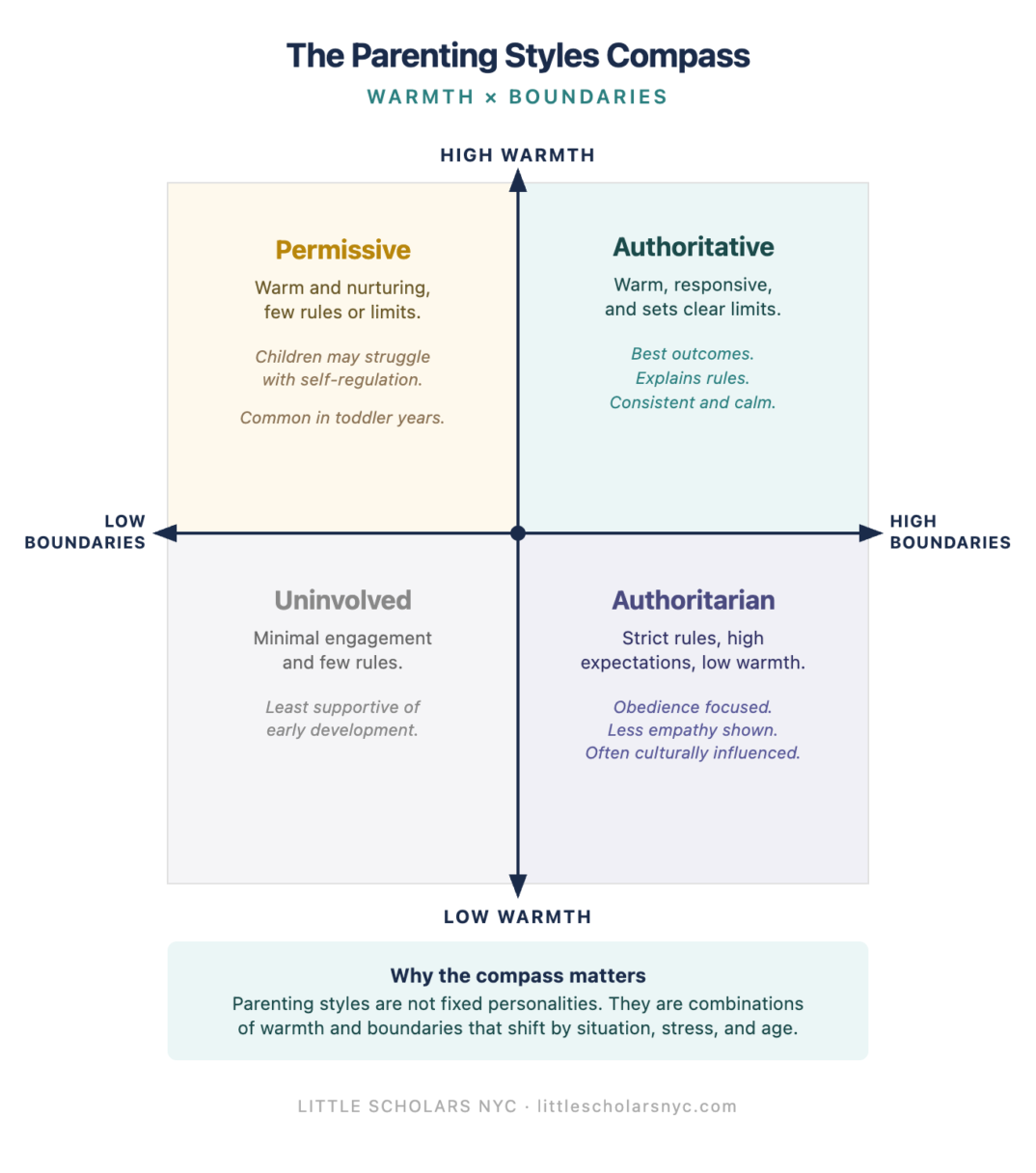
Most parents won’t fit perfectly into one category. Parenting styles describe overall patterns, not personalities. Many families naturally blend approaches depending on their child’s age, temperament, and the situation. The goal isn’t to earn a label. It’s to understand which habits best support healthy child development.
The 4 Core Parenting Styles
Developmental psychologist Diana Baumrind first identified three parenting styles in the 1960s. Researchers later added a fourth, creating the framework still used today.
| Parenting Style | Warmth | Boundaries | What young children typically experience |
| Authoritative | High | High | Emotional support paired with predictable routines and clear expectations |
| Authoritarian | Low | High | Firm rules with less explanation or emotional discussion |
| Permissive | High | Low | Plenty of affection but inconsistent limits |
| Uninvolved | Low | Low | Limited emotional responsiveness and little structure |
Authoritative Parenting
Authoritative parenting combines warmth with clear, consistent boundaries. Parents listen, explain expectations, and remain emotionally responsive while still following through with rules.
Typical characteristics include:
- High emotional responsiveness
- Clear, predictable expectations
- Age-appropriate independence
- Calm, consistent discipline
Imagine your three-year-old throws blocks after becoming frustrated.
Instead of yelling or ignoring the behavior, an authoritative parent might say:
“I can see you’re upset. Blocks aren’t for throwing because someone could get hurt. Let’s take a break together, then we’ll try again.”
The boundary stays firm, but the child’s emotions are acknowledged.
Research consistently shows authoritative parenting is associated with the strongest developmental outcomes, including better emotional regulation, social competence, and academic readiness (Pinquart, 2017). Rather than relying on fear or permissiveness, it gives children two things they need most: emotional safety and predictable expectations.
Authoritarian Parenting
Authoritarian parenting places a strong emphasis on obedience and rules while offering less flexibility or discussion.
Characteristics often include:
- High expectations
- Strict discipline
- Limited negotiation
- Fewer emotional explanations
If a toddler refuses to put away toys, an authoritarian response might be:
“Because I said so. Clean them up now.”
The expectation is clear, but the child has little opportunity to understand the reasoning behind it.
It’s important to recognize that parenting styles are also influenced by culture, family history, and personal experience. Many parents who grew up with authoritarian caregivers adopt similar approaches because they value respect, discipline, or safety—not because they lack warmth or love.
Permissive Parenting
Permissive parenting is highly nurturing but places relatively few consistent limits on behavior.
Common traits include:
- High warmth
- Few consequences
- Flexible rules
- Desire to avoid conflict
For example, if a preschooler asks for another cookie just before dinner, a permissive parent might initially say no but quickly change their mind after the child protests.
Children benefit from warmth and acceptance, but they also rely on predictable boundaries to develop self-control.
One important point often missed online is that permissive parenting is not the same as gentle parenting. We’ll explore that distinction shortly.
Uninvolved Parenting
Uninvolved parenting combines low responsiveness with limited structure or supervision.
Characteristics may include:
- Minimal emotional engagement
- Few expectations
- Limited communication
- Inconsistent involvement
This style is associated with the greatest developmental risks, although it’s important not to assume it reflects a lack of love. Serious stress, mental health challenges, financial hardship, or other family circumstances can make consistent caregiving difficult.
Rather than judging parents, the goal is to recognize when additional support may benefit both caregivers and children.
Other Parenting Styles You May Have Heard Of
Social media has introduced dozens of parenting labels over the past decade, but most fit somewhere within the four core parenting styles rather than replacing them.
Understanding these terms helps separate trends from established child development research.
Gentle parenting
As we previously mentioned, gentle parenting is not the same as permissive parenting. Gentle parenting emphasizes empathy, respectful communication, and emotional connection while maintaining clear, consistent boundaries. In practice, it aligns much more closely with authoritative parenting than permissive parenting.
For example, a gentle parent might acknowledge a toddler’s frustration about leaving the playground while still following through on the decision to go home.
Attachment parenting
Attachment parenting focuses on building secure relationships during infancy through responsive caregiving, physical closeness, and consistent attention to a baby’s needs.
For children under 18 months, this emphasis on responsiveness supports secure attachment, which research has linked to healthier emotional and social development later in childhood. Attachment parenting describes a philosophy for infancy rather than a separate parenting style.
Lighthouse parenting
Lighthouse parenting encourages parents to provide guidance and stability while allowing children to explore, make mistakes, and develop independence within safe boundaries.
Like gentle parenting, it generally fits within an authoritative framework rather than creating an entirely new category.
The growing number of parenting terms can make it seem like families need to choose the “perfect” philosophy. In reality, many of these approaches simply describe different ways of expressing the same core principles: warmth, consistency, and age-appropriate expectations.
Common myths about parenting styles
Before moving on, it’s worth clearing up a few common misconceptions.
Myth: Gentle parenting means never saying no.
Reality: Healthy gentle parenting includes firm, consistent boundaries.
Myth: One difficult day defines your parenting style.
Reality: Parenting styles describe long-term patterns, not isolated moments.
Myth: You have to fit perfectly into one category.
Reality: Most parents naturally blend approaches depending on their child’s age and the situation.
Myth: Choosing the “wrong” parenting style permanently determines your child’s future.
Reality: Children benefit most from caregivers who are warm, responsive, and willing to learn and adapt over time.
What Works Best for Children Under 5: What the Research Shows
Every family is different, but decades of child development research point to one consistent conclusion: young children thrive when parents combine warmth with clear, predictable boundaries. That is why authoritative parenting is consistently associated with the strongest developmental outcomes.
What authoritative parenting looks like, however, changes as children grow. A 10-month-old, a two-year-old, and a four-year-old all need something different from the adults caring for them.
Instead of asking, “Which parenting style is best?” a more helpful question is:
“What does my child need most at this stage of development?”
Infants (0–18 Months): Why Responsiveness Comes First
During the first 18 months of life, babies are learning one fundamental lesson:
Is the world safe, and will someone respond when I need help?
That is why responsiveness matters more than strict discipline during infancy.
Responding consistently to your baby’s cries, feeding cues, and need for comfort doesn’t “spoil” them. It helps build secure attachment, giving infants confidence that their needs will be met. That secure attachment becomes the foundation for later emotional regulation, confidence, and relationships.
For infants, authoritative parenting looks different than it does later in childhood. It means:
- responding promptly to hunger, discomfort, or fear
- establishing predictable feeding and sleep routines
- speaking calmly during diaper changes, feeding, and play
- providing comfort while gradually introducing routines
Rather than focusing on obedience, parents are helping babies develop trust.
Research based on attachment theory has consistently shown that responsive caregiving during infancy supports healthier emotional and social development later in childhood.
If you’re preparing for your baby’s first childcare experience, choosing an Infant Program that emphasizes responsive caregiving and consistent routines can help reinforce the secure relationships you’re building at home.
Toddlers (18 Months–3 Years): Structure Plus Warmth
Toddlers are famous for saying “no,” testing limits, and having emotional outbursts.
They’re not trying to make parenting difficult.
They’re discovering independence while still lacking the self-control to manage frustration consistently.
This is where authoritative parenting becomes especially powerful.
Instead of controlling toddlers through fear or avoiding boundaries altogether, authoritative parents provide calm, predictable limits.
That might sound like:
“You don’t want to leave the park. I understand. It’s hard to stop having fun. We’re leaving now, and you can choose whether to walk or hold my hand.”
The feeling is accepted.
The boundary stays the same.
One thing our teachers notice repeatedly is that toddlers rarely struggle because a rule exists. They struggle when the rule changes from one day to the next. Consistency helps children understand what to expect, reducing anxiety and making transitions smoother over time.
This stage is also when many parents begin wondering whether they’re being “too strict” or “too soft.”
In reality, toddlers usually benefit from:
- predictable daily routines
- two acceptable choices instead of unlimited options
- calm follow-through after setting limits
- reassurance after difficult moments
Tantrums are still normal. The goal isn’t to eliminate them. The goal is to teach children that emotions are welcome, even when certain behaviors aren’t.
Families navigating this stage may also find our guide to Managing Challenging Behavior helpful, as it explores practical strategies for responding to common toddler behaviors.
If your child attends a Toddler Program, you’ll likely notice many of these same strategies used throughout the classroom: consistent routines, simple choices, and patient guidance that helps children develop confidence without removing boundaries.
Preschoolers (3–5 Years): Explaining Rules and Building Independence
Between ages three and five, children become increasingly capable of understanding cause and effect.
They’re asking “why?” hundreds of times a day because they’re trying to make sense of the world.
This is the perfect time to shift from simply enforcing rules to explaining them.
Instead of saying:
“Because I said so.”
An authoritative parent might explain:
“We hold hands in the parking lot to stay safe from moving cars, backing vehicles, and busy traffic where drivers might not see us.”
Children may still resist.
That’s normal.
But explanations help preschoolers gradually internalize rules instead of following them only because an adult is watching.
At this stage, parents can also encourage more independence by allowing children to:
- put away toys independently
- help prepare simple meals
- choose weather-appropriate clothing from two options
- solve small disagreements before adults step in
In preschool classrooms, we often see that children who are given age-appropriate responsibilities at home become more confident participating in classroom routines. They’re often more willing to help classmates, clean up materials, and persist through small challenges because they’ve had opportunities to practice independence before entering school.
If your child is preparing for preschool, our guide on How to Get Your Child Ready for Preschool offers additional strategies for building independence and confidence before the first day.
A Lead Preschool Teacher’s Perspective on Parenting Styles
“Parents sometimes worry that choosing the ‘wrong’ parenting style will permanently shape their child’s future. What we see in our classrooms is much more encouraging. Children don’t need perfect parents. They need predictable adults. When expectations at home and school are warm, consistent, and supportive, children usually settle into routines, build confidence, and become more independent much more quickly.”
Mariana Korsunsky, M.S.Ed., Co-Founder & Director of Education at Little Scholars

How Your Parenting Style Affects What Your Child Needs from Daycare
Choosing a daycare isn’t just about finding a convenient location or a program with strong academics.
It’s about finding an environment that complements the values you’re already teaching at home.
One of the biggest misconceptions parents have is that daycare should mirror their parenting style exactly.
At Little Scholars, our high-quality early childhood programs consistently use authoritative practices because research and classroom experience show that children thrive with warm relationships, predictable routines, and clear expectations.
That doesn’t mean every family needs to parent identically.
It means children adjust more smoothly when the important adults in their lives communicate similar expectations around kindness, safety, and routines.
For example, if children are encouraged to help clean up after playtime both at home and in the classroom, those expectations quickly become part of their daily routine.
Likewise, if adults consistently acknowledge emotions while maintaining boundaries, children learn that feelings are acceptable—even when certain behaviors aren’t.
What if home and daycare don’t match?
Many parents ask whether differences between home and daycare will confuse their child. Usually, they won’t.
Children are remarkably adaptable. The key is communication.
If your family practices gentle parenting, ask how teachers respond to frustration and conflict.
If you value independence, ask how children are encouraged to solve problems before adults step in.
Rather than searching for identical philosophies, look for shared values: warmth, respect, consistency, and developmentally appropriate expectations.
Five questions to ask during a daycare tour
A daycare tour is one of the best opportunities to understand a program’s approach to child development.
Consider asking:
- How do teachers respond when toddlers have tantrums?
- How do you comfort crying infants?
- What happens if two children want the same toy?
- How do you encourage independence in preschoolers?
- How do teachers communicate classroom expectations with families?
The answers will tell you far more than a brochure ever could.
If you’re exploring options for your family, we invite you to book a tour at Little Scholars to see how our educators combine warmth, structure, and play-based learning to support every stage of early childhood development.
Can You Change Your Parenting Style?
Yes, absolutely. Parenting styles aren’t permanent identities. They’re patterns that naturally evolve as children grow and parents gain experience.
Most families use a blend of approaches throughout the week. That doesn’t mean you’ve adopted a completely different parenting style. Stress, sleep deprivation, work demands, and cultural expectations can all influence how parents respond in difficult moments. What matters is the overall pattern your child experiences over time. The good news is that small changes often make a meaningful difference.
Explain one more rule, one more time.
Follow through calmly instead of reacting emotionally.
Repair after a difficult interaction.
Those everyday moments shape your parenting approach far more than any label ever could.
Bottom Line
Choosing a parenting style isn’t about finding the perfect label. It’s about understanding what your child needs today and creating an environment where they feel both loved and supported as they grow.
At Little Scholars, we partner with families across NYC to create that consistency between home and school. If you’d like to see how our educators support infants, toddlers, and preschoolers through warm, structured, play-based learning, book a free tour, call (646) 759-0790, or email us at enroll@littlescholarsnyc.com. We’d love to show you how we help children build the confidence, curiosity, and independence that lasts far beyond the preschool years.
Frequently Asked Questions on Parenting Styles
What is the best parenting style for a toddler?
Research consistently suggests that authoritative parenting provides the strongest balance of warmth and structure for toddlers. It helps children develop emotional regulation while learning appropriate boundaries.
Is gentle parenting the same as permissive parenting?
No. Gentle parenting includes empathy and respectful communication, but it also maintains clear, consistent boundaries. That makes it much closer to authoritative parenting than permissive parenting.
Can parents use more than one parenting style?
Yes. Most parents naturally blend approaches depending on the situation, their child’s age, and developmental needs. Parenting styles describe long-term patterns rather than individual moments.
What parenting style does Little Scholars daycare follow?
At Little Scholars, we generally use an authoritative approach. Teachers build warm relationships with children while maintaining predictable routines, clear expectations, and developmentally appropriate boundaries.
Does my parenting style have to match my daycare exactly?
imageExact alignment isn’t necessary. What matters most is that home and school share similar values around communication, routines, and emotional support, giving children a consistent foundation as they grow.