
Many families in New York City looking for the best childcare programs look primarily at location, cost, or hours. While these factors are important, they don’t always indicate whether a program is truly helping a child’s development. The real value of early care is in how it affects a child’s communication skills, independence, emotional state, and social interactions over time.
Why parents should look beyond just supervision
Many parents look for child care programs, focusing primarily on location, hours, or cost. But convenience is only one part of the choice. A child spends a significant part of the day in such an environment, so this time mustn’t be just “supervised,” but also beneficial for development.
In the early childhood education field, Little Scholars NYC is often seen as an example of a structured model of child care that combines child development with play, routine, and social interaction. This format allows preschool teaching to be evaluated not only on the conditions of stay, but also on real-world results in skill development.
A high-quality children’s space helps to form communication skills, independence, attentiveness, and the ability to interact with other children. If the institution is limited to basic care, the child does not receive enough stimuli for active development. That is why it is worth evaluating not only safety and comfort, but also the approach to learning, the format of classes, and the communication of educators with children.
Care or development: what is the difference
Basic child care usually covers the child’s basic daily needs: nutrition, sleep, safety, and supervision during the day. For a short stay, this may be enough, but this format does not always contribute to the development of communication skills, concentration, or independence.
Today, parents are increasingly looking for not just a child care provider, but an environment in which the child can develop even before school.
Why early learning quality matters
The quality of early learning directly affects the child’s further development. In the first years of life, speech, memory, emotional stability and skills of interaction with other people are actively formed. That is why the environment in which the child is every day is of great importance.
Studies show that children who attend the best early childhood education programs near me adapt faster to new conditions, better perceive information and are more easily included in the educational process at school. They have a higher level of concentration, more often show initiative, and feel more comfortable in communicating with peers.
What does growth look like in a children’s environment?
A child’s long-term progress is not just about learning letters or numbers. It is important how a child behaves in a team, reacts to new situations, communicates with others and copes with simple daily tasks. That is why the best child care programs near me pay attention not only to educational activities, but also to the formation of practical skills that the child will need in school and everyday life.
Social development
One of the main skills at an early age is the ability to interact with other children. In a good children’s environment, children constantly learn to work together: to participate in joint games, negotiate, wait their turn and resolve minor conflicts without stress.
Such situations seem simple, but they are the ones that form confidence in communication and team interaction skills. The child gradually learns to express his thoughts, listen to others and feel comfortable among peers.
Content The NYC Childcare Advancements at Little ScholarsPartnering with Parents for Wholesome GrowthDiverse Early Learning Programs: Tailored for Every Little ScholarToddler Programs (1-2 y.o. & 2-3 y.o.)3k & UPK ProgramsAfterschool ProgramSummer Camps: When Learning Meets FunAccessibility: Education Beyond BoundariesPreparing for Tomorrow, TodayWhy Wait? Join the Little Scholars Family!Related Insights New York City is a hub … Interactive Learning Spaces at Little Scholars Daycare
Emotional development and control of emotions
For young children, emotions are often strong and difficult to understand. Therefore, the program must include activities that help the child recognize his own mood and respond correctly to different situations.
Through games, communication and support from educators, children learn to calm down, express emotions in words and gradually control their behavior. This helps reduce the number of conflicts and makes adaptation to the team much easier.
Formation of independence
Independence is formed not in one day, but through simple daily actions. Children learn to put away their things, clean up after classes, choose activities on their own or complete small tasks without the help of adults.
Such habits gradually form responsibility and confidence in their own actions. In the future, this helps the child adapt more easily to the school regime and new rules.
How to Evaluate a Childcare Program
Before choosing a childcare facility, you should look not only at the beautiful renovation or convenient location. A search for child care programs near me usually shows dozens of options. Still, the real quality of the program is noticeable in the details: how the day is organized, how educators work with children, and whether there is a systematic approach to development.
A good facility does not just keep a child busy throughout the day, but creates an environment in which he gradually learns to interact, concentrate, and become more independent.
Age-appropriate program
Children of different ages need different class formats. Toddlers need sensory games, mobile activities, and speech development through simple communication and play. Older children already need more structured tasks that help train memory, attention, and logic.
A quality program usually combines speech development, early math concepts, creative projects, and collaborative activities that encourage children to learn through interaction rather than memorization. It is important that the training does not look like “preschool lessons.” In a good environment, children learn through practice, communication, and everyday activities.

Communication with parents
One of the main indicators of a quality institution is openness to communication with parents. Educators should regularly talk about the child’s adaptation, successes, behavior, and difficulties, if any.
When communication is absent or limited to a few general phrases, it is difficult for parents to understand how the child feels in the group and whether the program is really beneficial. Constant contact helps to respond more quickly to changes and support the child’s development both at home and in the institution.
Organization of space
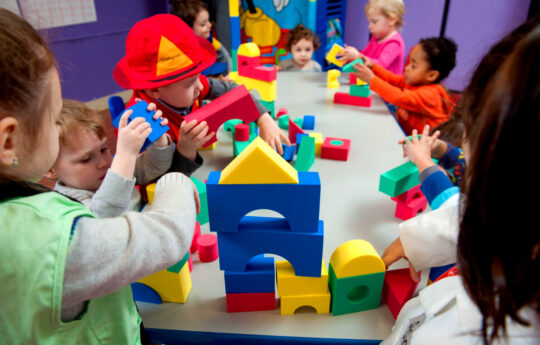
The way a class or group looks also affects children’s learning and behavior. In a well-organized classroom, children learn to interact with peers, take turns, express their needs, and participate in group activities. These everyday experiences gradually strengthen communication skills and emotional confidence.
When each zone has its own purpose, it is easier for children to concentrate, stick to a routine, and interact comfortably with each other throughout the day.

The experience of Little Scholars NYC programs shows that the greatest progress in preschool age is achieved when learning is integrated into everyday situations, rather than existing as separate “lessons.”
Supporting Growth at Every Stage of Early Childhood
Modern institutions build learning by age stages. This allows for the most effective development of children. Key strengths of this approach:
- structured early childhood education with clear age-specific milestones;
- combination of play-based learning and academic preparation;
- emphasis on emotional and social development;
- stable routines that build confidence and adaptation;
- development of independence through daily practical tasks.
Infant and toddler programs
For the youngest children, early learning should begin in a calm, safe, and predictable environment. The infant program supports sensory exploration, early communication, motor development, and daily routines that help children feel secure. The toddler stage builds on this foundation by encouraging movement, curiosity, social interaction, and the first steps toward independence through age-appropriate activities and guided play.
Preschool and pre-K programs
At the preschool and pre-K stage, the focus shifts toward school readiness and more structured learning. Children develop language, early math and literacy skills, attention span, confidence in group settings, and the ability to follow instructions and complete simple tasks independently. These programs also help strengthen communication, problem-solving, and cooperation, which are essential for a smooth transition into the classroom environment.
Extended care
Extra time at the facility provides an opportunity to consolidate skills through play and practice. This is especially important for working parents.
Parent Checklist Before Enrollment
Before choosing among various child care options, it is worth preparing a list of criteria in advance. A good impression of the premises does not mean that the program is really suitable for the child. When getting to know the institution, it is better to pay attention not only to the living conditions, but also to the organization of learning, the atmosphere in the groups, and the approach of the educators to the children.
Questions for the tour
When visiting the institution, it is worth asking a few simple but important questions:
- What educational program is used?
- How is the child’s development and adaptation assessed?
- What experience do the child care provider and educators have?
- How is the day organized in the group?
- Is there regular feedback for parents?
The answers help to understand how systematically the institution’s work is built and whether the program has a clear structure.
Red flags to avoid
Several points are worth paying special attention to when choosing:
- lack of a clear program;
- poor communication with parents;
- chaotic organization of classes;
- constant staff turnover;
- overloaded groups.
Such signals often indicate unstable operation of the institution or the lack of a systematic approach to the development of children.
Comparing care programs
| Criteria | Basic Care | Development Program |
| Educational component | Minimal | Structured |
| Social development | Limited | Active |
| Independence skills | Weakly developed | Systematically developed |
| Communication with parents | Rare | Regular |
This chart helps you quickly see the difference between simple care and a program that truly supports your child’s development. When choosing, it is important to evaluate not only safety or comfort, but also how the environment affects the child’s independence, communication, and adaptation to new conditions.
Conclusion: Choosing Development-Focused Care
Choosing a child care institution affects not only the child’s comfort during the day, but also its further development. It is at an early age that communication skills, independence, and learning habits are formed.Therefore, when choosing, you should focus not only on convenience or cost, but also on the quality of the program. If you would like to learn more about structured early childhood programs in NYC or schedule a visit, please call the admissions team for more information and guidance.
FAQ
What are the best child care programs near me for early development?
Programs with a structured learning approach, qualified educators, and activities adapted to the child’s age usually provide the strongest support for early development.
How can parents understand that a program supports learning?
It is worth paying attention to the presence of a curriculum, regular feedback for parents, and how the child adapts and develops in the group.
What should a strong child care provider offer?
A good institution combines a safe environment, daily developmental activities, and constant communication with parents.
Why are daily routines important for children?
A stable regime helps children adapt more easily, feel more confident, and get used to the learning process faster.
What child care options are available for families?
Parents can choose between daycare centers, private programs, home care, or combined formats of early development.
How does preschool teaching support social skills?
Through group games, shared tasks, and daily communication, children learn to interact, listen to others, and work as a team.
What should parents ask before enrollment?
Before enrolling, it is worth clarifying the program of classes, the experience of educators, the adaptation format, and the methods of assessing the child’s development.